
Dogs and
sheep were among the first animals to be domesticated.
Domestication (from the Latin domesticus: "of the home") is the cultivating or taming of a population of organisms in order to accentuate traits that are desirable to the cultivator or tamer. The desired traits may include a particular physical appearance, behavioral characteristic, individual size, litter size, hair/fur quality or color, growth rate, fecundity, lifespan, ability to use marginal grazing resources, production of certain by-products, and many others.Domesticated organisms may become dependent on humans or human activities, since they sometimes lose their ability to survive in the wild.
Domestication differs from
taming in that it may refer not simply to a change in organisms' behaviors or environmental socialization, but also potentially even in their phenotypical expressions and genotypes. The word
domestication also is more commonly used to mean a change within whole populations, while
taming is more commonly used to mean a change within individuals. Furthermore, taming typically applies only to animals and their becoming habituated to human presence, while domestication is a broader term and can include plants, fungi, and other types of organisms.
Plants domesticated primarily for
aesthetic enjoyment in and around the home are usually called
house plants or
ornamentals, while those domesticated for large-scale food production are generally called
crops. A distinction can be made between those domesticated plants that have been deliberately altered or selected for special desirable characteristics (see
cultigen) and those plants that are used for human benefit, but are essentially no different from the wild populations of the species. Animals domesticated for home companionship are usually called
pets, while those domesticated for food or work are called
livestock or
farm animals.
Animals
Archaeozoology has identified 3 classes of animal domesticates: (1) commensals, adapted to a human niche (e.g., dogs, cats, guinea pigs); (2) prey animals sought for food (e.g., cows, sheep, pig, goats); and (3) targeted animals for draft and nonfood resources (e.g., horse, camel, donkey).

Hereford cattle, domesticated for beef production.
- Flexible diet – Creatures that are willing to consume a wide variety of food sources and can live off less cumulative food from the food pyramid (such as corn or wheat), particularly food that is not utilized by humans (such as grass and forage) are less expensive to keep in captivity. Carnivores by definition feed primarily or only on flesh, which requires the domesticators to raise additional animals just to feed them, though they may exploit sources of meat not utilized by humans, such as scraps and vermin.
- Reasonably fast growth rate – Fast maturity rate compared to the human life span allows breeding intervention and makes the animal useful within an acceptable duration of caretaking. Some large animals require many years before they reach a useful size.
- Ability to be bred in captivity – Creatures that are reluctant to breed when kept in captivity do not produce useful offspring, and instead are limited to capture in their wild state. Creatures such as the panda,antelope and giant forest hog are territorial when breeding and cannot be maintained in crowded enclosures in captivity.
- Pleasant disposition – Large creatures that are aggressive toward humans are dangerous to keep in captivity. The African buffalo has an unpredictable nature and is highly dangerous to humans; similarly, although the American bison is raised in enclosed ranges in the Western United States, it is much too dangerous to be regarded as truly domesticated. Although similar to the domesticated pig in many ways, Africa's warthog and bushpig are also dangerous in captivity.
- Temperament which makes it unlikely to panic – A creature with a nervous disposition is difficult to keep in captivity as it may attempt to flee whenever startled. The gazelle is very flighty and it has a powerful leap that allows it to escape an enclosed pen. Some animals, such as the domestic sheep, still have a strong tendency to panic when their flight zone is encroached upon. However, most sheep also show a flocking instinct, whereby they stay close together when pressed. Livestock with such an instinct may be herded by people and dogs.
- Modifiable social hierarchy – Social creatures whose herds occupy overlapping ranges and recognize a hierarchy of dominance can be raised to recognize a human as the pack leader:
- Tapirs and rhinoceroses are solitary and do not tolerate being penned with each other.
- Antelope and deer—except for reindeer—are territorial when breeding and live in herds only for the rest of the year.
- Bighorn sheep and peccaries have non-hierarchical herd structures and do not follow any definite leader; instead, males fight continuously with each other for mating opportunities.
- Musk ox herds, although they have a defined leader, maintain mutually exclusive territories and two herds will fight if kept together.
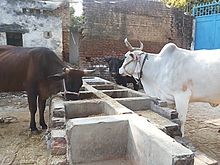
Cow domestication in North India for milk production.
However, this list is of limited use because it fails to take into account the profound changes that domestication has on a species. While it is true that some animals retain their wild instincts even if born in captivity, e.g. laying hens,
[13] pigs
[14] and laboratory mice,
[15] some factors must be taken into consideration.
Number (5) may not be a prerequisite for domestication, but rather a natural consequence of a species' having been domesticated. In other words, wild animals are naturally timid and flighty because they are constantly faced by predators; domestic animals do not need such a nervous disposition, as they are protected by their human owners. The same holds true for number (4) – aggressive temperament is an adaptation to the danger from predators. A Cape buffalo can kill even an attacking lion, but most modern large domestic animals were descendants of aggressive ancestors. The wild boar, ancestor of the domestic pig, is certainly renowned for its ferocity; other examples include the
aurochs (ancestor of modern cattle), horse, Bactrian camels and yaks, all of which are no less dangerous than their undomesticated wild relatives such as zebras and buffalos. Others have argued that the difference lies in the ease with which breeding can improve the dispositions of wild animals, a view supported by the failure to domesticate the
kiang and
onager. On the other hand, for thousands of years humans have managed to tame dangerous species like bears and cheetahs
[citation needed] whose failed domestications had little to do with their aggressiveness.
Number (6), while it does apply to most domesticated species, also has exceptions, most notably in the domestic
cat and
ferret, which are both descended from strictly solitary wild ancestors but which tolerate and even seek out social interaction in their domestic forms. Feral domestic cats, for example, naturally form colonies around concentrated food sources, and will even share prey and rear kittens communally, while wildcats remain solitary even in the presence of such food sources. Zoologist
Marston Bates devoted a chapter on domestication in his 1960 book
The Forest and the Sea, in which he talks a great deal about how domestication alters a species. Dispersal mechanisms tend to disappear for the reason stated above, and additionally, because people provide transportation for them, domestic chickens and turkeys have a greatly reduced ability to fly. Similarly, domestic animals cease to have a definite mating season, so the need to be territorial when mating loses its value, and if some of the males in a herd are castrated, the problem is reduced even further. What he says suggests that the process of domestication can itself make a creature domesticable. Besides, the first steps towards agriculture may have involved hunters keeping young animals, who are always more impressionable than the adults, after killing their mothers.
 The American black bear (Ursus americanus) is a medium-sized bear native to North America. It is the continent's smallest and most widely distributed bear species. Black bears are omnivores with their diets varying greatly depending on season and location. They typically live in largely forested areas, but do leave forests in search of food. Sometimes they become attracted to human communities because of the immediate availability of food. The American black bear is the world's most common bear species.
It is listed by the
IUCN as a "
least concern" species, due to its widespread distribution and a large global population estimated to be twice that of all other bear species combined. Along with the
brown bear, it is one of only two of the eight modern bear species not considered globally threatened with extinction by the IUCN. American black bears often mark trees using their teeth and claws as a form of communication with other bears, a behavior common to many species of bears.


